UNC Charlotte Data Science Students Secure Third Place in Global WiDS 2026 Datathon Challenge
By Lindsay Mongillo
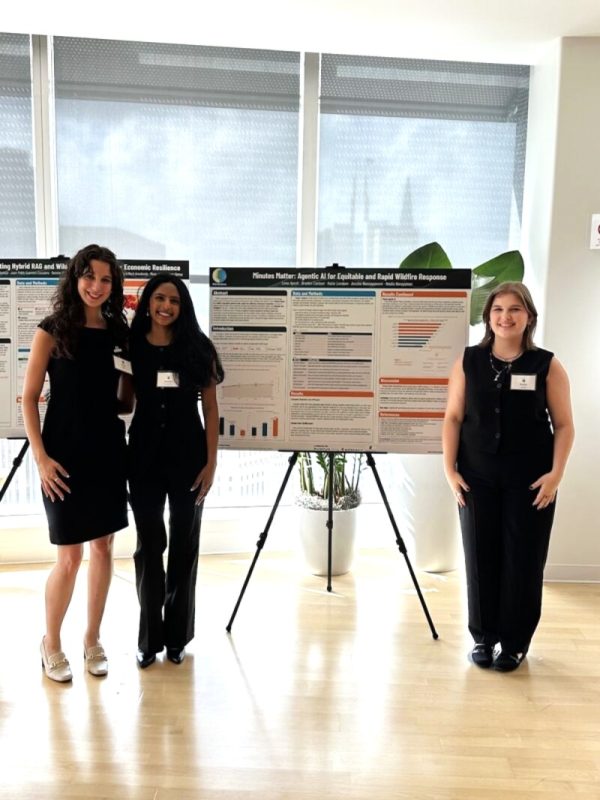
A team of standout students from the School of Data Science (SDS) at UNC Charlotte achieved third place in the prestigious Women in Data Science (WiDS) University Datathon 2026 Challenge. The UNC Charlotte students competed against more than 20 teams from Tecnológico de Monterrey, Northeastern University, University of San Francisco, Georgia Tech, and Santa Clara University. The team demonstrated how technical prowess and real-world storytelling can drive social impact.
The team—composed of Lena Ayesh, Katie Leedom, Anisha Nannapaneni, and Nadia Narayanan—tackled the 2026 theme: “Predicting Wildfire Impact: From Infrastructure to Equity.” Under the mentorship of Professor Ilieva Ageenko and Professor Chris Dong, the students developed a comprehensive solution that bridged the gap between complex data and life-saving applications.
Innovation in Action: Minutes Matter
The team’s project, titled Minutes Matter, originated from a desire to reduce evacuation times and improve safety for vulnerable populations during wildfires.
The product features a dual-sided platform:
- For Evacuees and Families: A Life360-style circle where users can monitor family members in fire-prone areas. If a wildfire is detected within a customizable radius, users receive instant notifications to check on loved ones.
- For First Responders: An API designed to integrate with existing fire department mapping software. This layer allows firefighters to see real-time evacuation statuses—such as whether a resident has already left or has mobility issues requiring specialized transport.
To ensure the product’s viability, the team conducted extensive market research, interviewing more than 14 industry experts, including fire chiefs and public safety officials. “We literally walked into fire stations and asked, ‘Can we talk to people?’” said Katie Leedom. This boots-on-the-ground approach helped the team pivot from a purely theoretical model to a viable market product.
Beyond the Numbers: The Power of Storytelling
While the competition was technically rigorous, the UNC Charlotte team stood out for their exceptional communication skills. Bryan Muñoz from Women in Data Science noted that the judges were so impressed that they considered creating a new category for presentation skills specifically because of this group.
Anisha Nannapaneni emphasized that the journey was about more than just coding. “It was a lot more than just the technical aspect,” she said. “There were so many soft skills… seeing how we can do better and really honing in on storytelling for the audience.”
A Foundation for Success
The team credited much of their success to the School of Data Science’s Studio 3 course, which taught them end-to-end pipeline management—from data storage in Supabase to final deployment. Additionally, their participation in the Accenture Apprenticeship program provided critical industry exposure and mentorship on how to present data to executives.
The impact of this challenge is already being felt in the students’ professional lives:
- Lena Ayesh successfully used the Datathon project as the basis for her Fulbright research application, which has since been accepted.
- Nadia Narayanan contributed to the project’s UI/UX design while studying abroad, proving the team’s ability to collaborate across global time zones.
“We wanted to actually have an impact… If it doesn’t actually help the people that you’re trying to serve, then what’s the point?”
— Katie Leedom, UNC Charlotte Student
A Proud Moment for Niner Nation
Professor Ilieva Ageenko expressed immense pride in the students’ initiative, noting that they volunteered for the challenge themselves. “They were very passionate, had a lot of interest, and that’s how they were so successful,” Ageenko said.
Despite competing against some of the world’s toughest university programs, the team’s third-place finish solidifies UNC Charlotte’s growing reputation as a leader in data science education. As team mentor Bryan Muñoz put it, their “X-factor” was a willingness to jump into the unknown and take a risk on a global stage.