When Data Meets Human Behavior: A Spotlight on Professor Sijia Qian
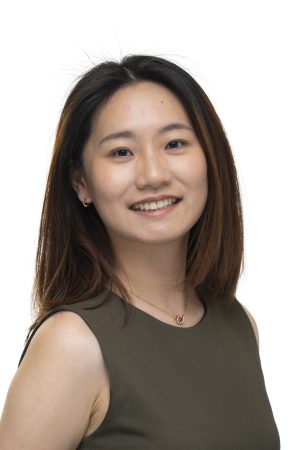
By Jordan Minor
Professor Sijia Qian brings together her interests in information integrity, data, and Communication to explain why information integrity matters in today’s expanding AI world while sharing what makes students in the Department of Data Science memorable as she continues to learn from them.
Your work specifically addresses multimodal information environments, which combine text, altered images, and AI-generated video or audio. Why is navigating an environment that hits multiple senses so much more complex for the human brain, and how does it shift the way we evaluate information integrity?
My work tries to understand how people evaluate information in these richer, messier environments, and how we can design tools, education, and interventions that help them make more informed judgments. One reason multimodal information environments are so complex is that visual content often feels like direct evidence of reality. We have this common idea that “seeing is believing,” and there is some truth to how powerful that experience can be. When people see an image, the information can feel more immediate, emotional, and trustworthy than if they were simply reading a written claim.
At the same time, this is exactly how people consume information today. On online platforms, information rarely appears as text alone. It comes through captions, images, videos, sound, and now increasingly AI-generated or AI-edited content. That means evaluating information integrity is harder than before. AI-generated content can look and sound very realistic, and multimodal messages often create a stronger impression than text alone. When people encounter this content quickly on social media, it becomes more difficult to tell what is authentic, what has been edited, and what to trust. The broader concern is not only that people may believe a single misleading post. It is also that repeated exposure to altered or AI-generated media may create uncertainty about digital media more generally. Over time, this can shape how people understand health, science, and political issues, and affect trust in the media, experts, and public institutions.
What drew you to the UNC Charlotte School of Data Science and to continue your research and teach future leaders?
What drew me to the UNC Charlotte School of Data Science is its interdisciplinary nature. The faculty come from many different fields, and I think that is exactly what we need for the kinds of challenges we face today. Issues around information integrity, AI, and public trust cannot be solved by a single discipline. They require people with different kinds of expertise to work together.
It is exciting to join SDS at a moment of growth, especially with the launch of the Ph.D. program. I have really enjoyed working with students who are not only technically strong but also thoughtful about the social, ethical, and human implications of data science.
You study information integrity across health, science, and political domains—three areas where public trust has taken a major hit recently. Based on your research, what does a truly resilient information ecosystem look like, and how can we empower the public to rebuild societal trust in data?
I think a truly resilient information ecosystem requires effort at multiple levels: individuals, platforms, and institutions. To me, resilience does not mean that people will never encounter misinformation or low-quality information. That is probably unrealistic in today’s media environment. Instead, a resilient system is one where accurate information can circulate effectively, misleading information does not spread unchecked, and people feel equipped to evaluate what they see.
Your PhD is in Communication with an emphasis on Computational Social Science. For students entering the field, how does studying data through the lens of human communication and media literacy change the way you interpret numbers compared to traditional, purely technical computer science?
One thing my communication background brings is a strong attention to concepts and measurements. A lot of the data I work with is ultimately about people: their attitudes, beliefs, and behaviors. That includes social media data, survey data, and experimental data, so when I look at data, I am always thinking about the human communication process behind it.
I sometimes think of this as combining two approaches. Data science can be very powerful in a bottom-up way: looking at large datasets, identifying patterns, and building models. Communication and social science often bring a more concept-driven approach: starting with theory, research questions, and measurement. For me, the most exciting work happens when we bring these approaches together. We can ask meaningful questions about human communication while also using computational methods to study those questions at a larger scale.
You teach Research Design for Data Science (DTSC 8600). With today’s AI-mediated media landscape constantly evolving and private platforms tightening access to data pipelines, what is the biggest challenge facing the next generation of data science researchers in designing ethically sound, accurate studies?
I think one of the biggest challenges is that we have more data than ever, but understanding what that data actually represents is a different question. In data science, we often work with datasets that were collected by platforms or organizations we did not design ourselves. So it is important for researchers to ask: Where did this data come from? Who is included or excluded? What behaviors does it capture, and what does it miss? That is where domain knowledge becomes really important. Data do not speak for themselves. We need to understand the social context behind the data.
Another major challenge is thinking carefully about the role of AI in the research process itself. AI tools can help researchers collect, organize, analyze, and interpret data, but they should not replace human judgment. We need to know when these tools are useful, where their limitations are, and how to build human evaluation into the process. For the next generation of data science researchers, I think the key is not just learning how to use powerful tools, but learning how to ask better questions about the data, the methods, and the consequences of the research.
What makes SDS students stand out to you as a professor?
What stands out to me most about SDS students is the diversity of backgrounds and experiences they bring into the classroom. Many of them come from different disciplines, professional sectors, and life experiences, and that makes our conversations much richer. In a data science classroom, students are not only learning methods and technical tools; they are also bringing different ways of thinking about problems and their impact.
I have been especially impressed by how often students connect what we discuss in class to real-world questions they have encountered in their own work or communities. That makes the classroom dynamic much more engaging, because we are not just talking about data in the abstract. We are thinking about how data is collected and interpreted in real settings.